
Understanding Oyster Sizes and Their Serving Options
Start with the label, not the legend
British seafood has a romantic reputation. We picture Whitstable natives on crushed ice, hand-dived scallops from a Highland loch, and crabs landed at dawn on the Cornish coast. The reality is often just as good, but only if you know what you are buying. The single most useful habit you can develop is to ask where the fish came from and how it was caught. A counter that can answer that question clearly is usually a counter worth buying from.
Environmental impact in seafood is not one problem but several. It includes how many other creatures are caught alongside the target species, how much seabed is disturbed, whether the stock is healthy, and how far the catch has travelled. Good sourcing information addresses most of these. Vague sourcing information addresses none of them.
What clear sourcing information looks like
You are looking for specifics, not sentiment. "Sustainably sourced" on its own tells you almost nothing. "Hand-dived scallops, Sound of Mull, landed at Oban" tells you plenty. The more precise the information, the easier it is to make a judgement.
- Species and stock: the common name, and ideally the scientific name or the management area. Stocks vary hugely from region to region.
- Capture method: hand-dived, pot-caught, line-caught, trawled. This is often the most important detail on the label.
- Port or landing place: a named harbour, not just "UK waters".
- Farming method: rope-grown, bottom-grown, suspended culture, onshore tank.
- Certification: recognised schemes can be a useful shortcut, but treat them as one signal among several rather than a guarantee.
If a shop or stall cannot answer these questions, that is information too. Many independent fishmongers will know their suppliers personally, and will happily tell you more than you asked for.
Oysters: the shellfish we do best
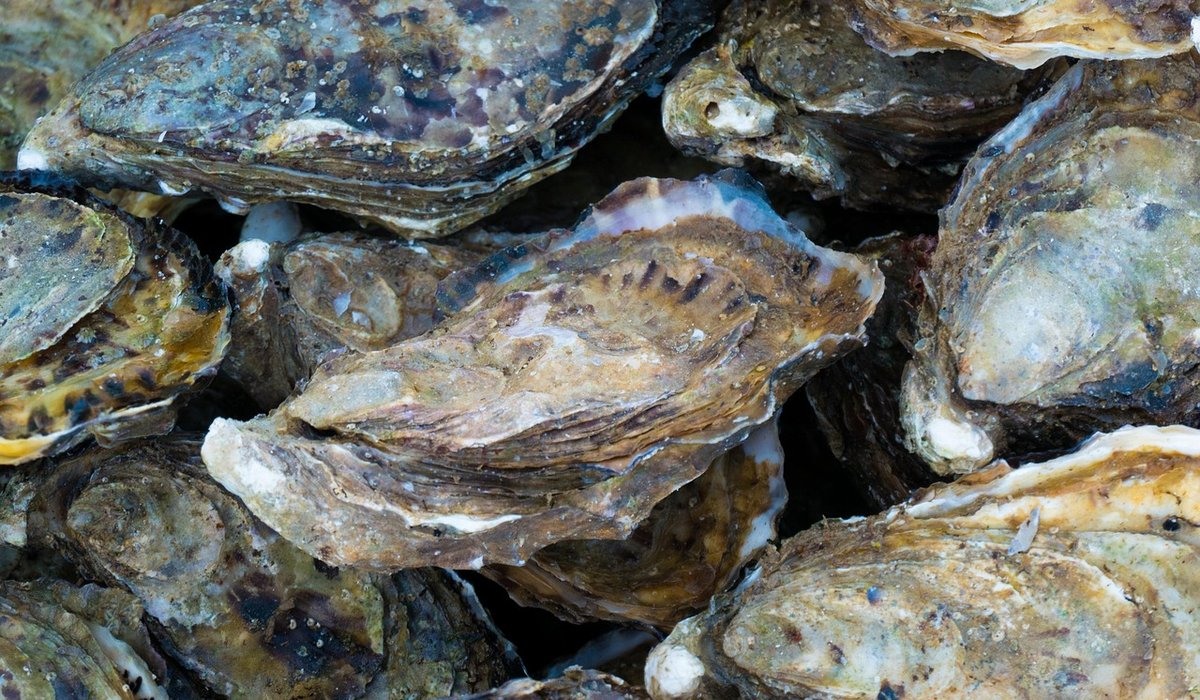
Britain and Ireland produce some of the finest oysters in the world, and native oysters (Ostrea edulis) are the traditional champion. They are slower-growing than Pacific oysters and their wild stocks are fragile, which is why most native oysters you buy are farmed or carefully managed. If you see native oysters sold with a named river or fishery, ask about the fishery's restocking practice. Many now work with hatchery-reared seed rather than taking from wild beds.
Pacific oysters (Magallana gigas) are grown in huge numbers around our coasts. They are hardy, fast-growing and generally lower impact in production terms. The trade-off is that they can spawn in the wild in warmer years, and in some estuaries they have spread beyond their leases. On a plate, though, they are excellent and often better value.
Either way, oysters are one of the least demanding proteins we can eat. They filter feed on naturally occurring plankton, need no feed inputs, and their reefs and cages can provide habitat for other species. Choose oysters that are grown in the water, not just held in tanks, and ask what they have been fed if they come from a purification facility.
Mussels, clams and the rope-grown advantage
Mussels are the quiet hero of British shellfish. Rope-grown mussels are cultivated in the water column, so they never touch the seabed. They filter plankton, improve local water clarity, and require no feed, no antibiotics and very little fuel to harvest. They are also cheap, which makes them an easy weekly habit rather than an occasional treat.
Clams and cockles are a different story. Many are still gathered by hand or by dredge from intertidal flats, which are sensitive, productive habitats. Hand-gathered cockles from well-managed beds are a good choice; large-scale mechanical harvesting in the same areas less so. Ask whether the bed is managed under a several order or a local fishery plan, and whether there is a closed season.
A simple rule holds across the group: the less the gear touches the seabed, the lighter the footprint. Suspended and rope-grown shellfish sit at the top of that list.
Seasonality is real, and it matters
British shellfish have genuine seasons, and respecting them helps both stocks and flavour. Native oysters are traditionally only eaten in months containing an "r", roughly September to April, because that is when they are in condition and not spawning. Pacific oysters are available year-round, but they are at their best in the cooler months too.
- Native oysters: September to April, avoiding the summer spawning period.
- Pacific oysters: available all year, best in autumn and winter.
- Mussels: autumn and winter, though farmed supplies are steady throughout.
- Brown crab and lobster: peak in summer, but check for berried hens and minimum landing sizes.
- Scallops: hand-dived supplies run year-round; dredged stocks often have local closures in summer.
Seasonality is not nostalgia. It is a practical tool for spreading fishing pressure and letting breeding stock recover.
Small habits that add up
You do not need to become an expert to make better choices. Buy from people who are willing to talk, favour shellfish that filter rather than forage, and be suspicious of any counter that cannot tell you which coast your dinner came from. Ask about gear before you ask about price. Rotate the species you cook with, so no single stock carries your whole appetite.
Above all, treat shellfish as produce rather than commodity. Handled well and bought well, a bag of rope-grown mussels or a dozen natives is one of the most environmentally sound and quietly luxurious things on any British table.
LEAVE A COMMENT